Jump to a section
Developing effective business continuity starts with understanding the space between your current operational reality and the required future state. Gap assessments provide a structured view of where capabilities, controls, and dependencies fall short of regulatory expectations or recognised standards. With this concrete evidence, organisations have firm ground to stand on when conducting further business continuity development.
What Is a Gap Assessment?
A gap assessment in a business context is a process organisations use to identify areas of improvement between their current practices and the desired future state. These goals are typically tied to meeting industry standards and defined governance and risk requirements, either from external regulation or new internal policy.
Difference Between Gap Assessment and Gap Analysis
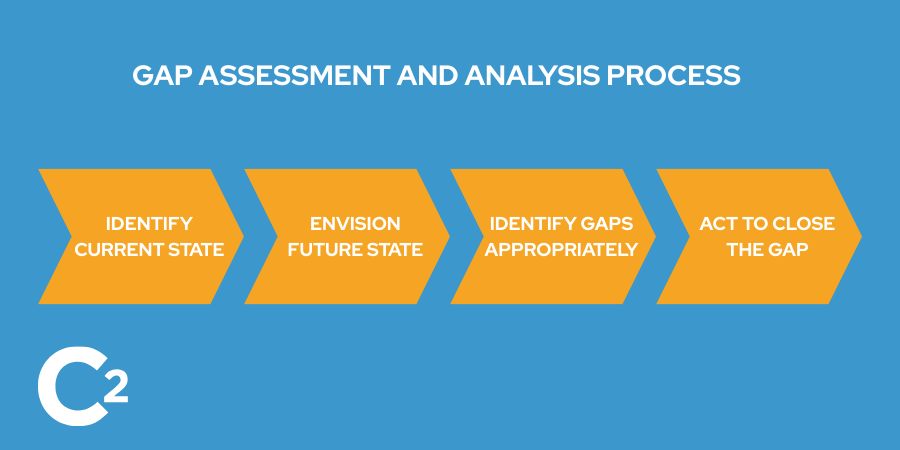
A gap assessment defines what your performance gaps are. A gap analysis uncovers why these gaps exist and helps you identify what can be done about them. Only once gaps are formally recorded through a gap assessment can organisations choose to perform gap analysis to inform their next steps. They are two parts of a larger process that takes your organisation from A to B.
Benefits of Gap Assessments
Approximately 8 in 10 Business Continuity Institute survey respondents said that resilience managers should be good at implementing plans and processes. Without knowing what is missing and needs to be changed, it is hard to do either. When your organisation has identified gaps, however, it can take advantage of the following benefits.
Clear baseline
The primary function of a gap assessment is to answer the question, "Where are we today?" Instead of relying on assumption-based reports, there is a documented view of the organisation's current capability. This provides evidence-backed confidence when reporting to boards, auditors, or regulators. When they ask where your figures are from, you will be ready with an answer.
Strong compliance
Accurate gap assessment can help your organisation map its current controls against standards such as ISO 22301 for business continuity. Think of it like writing a checklist. Each gap in your current performance is an item to fill. As you tick them off, your organisation steps closer to compliance.
Transparent governance
Transparent governance is about not only what exists and what does not, but who owns the business processes and is accountable for risk management. By determining areas of uncertainty where responsibilities are unclear, organisations can assign leaders as needed. According to Gartner Data, 80% of businesses without a sense of urgency in their data governance will fail by 2027. Don't be one of them.
Accurate risk visibility
The step before risk management is risk visibility. For example, a healthcare facility may assume its critical supplies are covered because contracts are in place, while lacking visibility into supplier dependencies and a real-time view of stock levels across departments. By identifying the risk of increased supply demand or supplier failure, they can implement risk management more accurately.
Operational efficiency
Reduce wasted effort on gap analysis by understanding exactly where work is required, and where it is not. Instead of teams duplicating reviews or chasing the wrong evidence, you can use a single, evidence-backed view of gaps to inform future actions. This improves coordination between departments and reduces time spent reconciling inconsistent information. The result can be faster decision-making and smoother incident recovery time.
Who Needs a Gap Assessment?
Any sector with regulatory oversight, critical services, or complex operations can benefit from a gap assessment. In many cases, it is essential for regulatory requirements. Some of the main ones include:
- Financial Services: Required for Financial Conduct Authority (FCA) operational resilience, to help ascertain impact tolerances and conduct scenario testing for managing financial records.
- Public Sector and Government: Compliance with internal audit frameworks and Civil Contingencies Act duties, including providing evidence for assurance and governance reviews.
- Utilities and Critical National Infrastructure: Identifies weaknesses affecting service continuity and public impact, such as cybersecurity concerns or ageing infrastructure.
- Healthcare organisations: Highlighting gaps affecting patient safety and service delivery supports assurance against national resilience and emergency planning requirements.
- Technology and Digital Services: Helps third-party risk assessment and supply chain assurance, while demonstrating control coverage for stakeholders, customers, and auditors.
- Educational institutions: Identifies gaps across governance, incident response, and continuity arrangements, in line with statutory government regulations.
How to Conduct a Gap Assessment
Conducting a gap assessment means focusing on the what, rather than the why. By gaining a deep understanding of the current and desired states of your organisation, the gap analysis process that follows will be easier to implement. For a solid starting point, follow this guide.
1. Define benchmark
Confirm the requirement you are assessing against before any review begins. This may be an external regulatory framework, such as FCA operational resilience, or an internal policy and control set. To ensure that gaps are measured against a fixed reference point, the benchmark must be explicit and version-controlled.
2. Set scope
Maintain clarity by setting clear boundaries for what the assessment will and will not cover. The scope should explicitly state which parts of the organisation are included, such as services, locations, systems, suppliers, and third parties being assessed. This should also encompass the expected assessment time range.
3. Review existing documentation
Assess what is currently in place using documented evidence. This may include policies, business impact analysis (BIA), plans, mapping outputs, exercise reports, incident records, and system data. Where evidence does not exist, the absence itself becomes a finding. If data is difficult to source and organise, consider using a fit-for-purpose software platform to do so.
4. Record gaps
Compare the benchmark to the evidence reviewed and formally record any shortfall. Each gap should clearly state the requirement, the current position, and what is missing or incomplete. Gaps must be factual, concise, and trace back to evidence, as recorded in your document control.
5. Prioritisation
Organise your identified gaps by priority level. For example: potential service disruption, customer harm or regulatory exposure. Refer back to the originally defined benchmark to decide which issues are most important to tackle first. A gap assessment is complete when all requirements are assessed, evidence is recorded, and gaps are formally logged by priority.
Gap Analysis Template
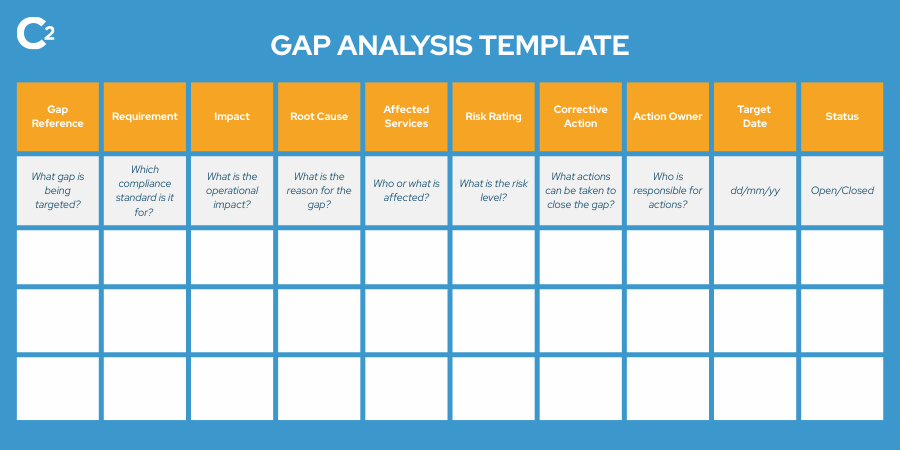
After collecting data with the gap assessment, the gap analysis process is the natural next step. A gap analysis template is a document that your organisation can use to extend your process from the initial gap assessment into a practical action plan for development.
Business Continuity Expertise Supports Gap Assessments
Many organisations have continuity frameworks in place but lack a clear, evidence-backed view of where requirements are not met. A structured gap assessment provides that clarity, giving you a defensible baseline and a clear starting point for improvement.
Meridian Business Continuity Management Software (BCMS) helps you to create structured assessment workflows and track the progress of risk assessment planning. With evidence capture and scoring and audit-ready reporting, you will have everything you need in advance of conducting a gap analysis.
Require more support? We also provide professional services to assist organisations in building out their business continuity gap assessment. Get in touch today to see how we can help.
Written by Donna Maclellan
Lead Risk and Resilience Analyst at Continuity2
With a first-class honours degree in Risk Management from Glasgow Caledonian University, Donna has adopted a proactive approach to problem-solving to help safeguard clients' best interests for over 5 years. From identifying potential risks to implementing appropriate management measures, Donna ensures clients can recover and thrive in the face of challenges.

Written by Donna Maclellan
Lead Risk and Resilience Analyst at Continuity2
With a first-class honours degree in Risk Management from Glasgow Caledonian University, Donna has adopted a proactive approach to problem-solving to help safeguard clients' best interests for over 5 years. From identifying potential risks to implementing appropriate management measures, Donna ensures clients can recover and thrive in the face of challenges.